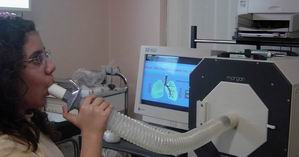
The spirometry is a simple but fundamental consideration in monitoring respiratory function. It is valuable both in diagnosis and monitoring of various lung diseases, such as
* Of asthma
* Chronic obstructive pulmonary disease, etc.
This review is the spirometer (note here that there are many types spirometry). The spirometer has usually a tube one end of which is connected to the machine and adjust the other a mouthpiece through which by the interviewee, as shown by the photo , inhale and expire on power.
But it needs good cooperation from the question (as can inhaling more deeply and immediately after maximum-sharp and prolonged expiration) in order to get reliable results.
Figure 1 is spirometry a young 20 years old, healthy.
Figure 1
It is measured inhaled and exhaled air volume according to the chrono.Analoga results, we can know whether the interviewee has a normal respiratory function, or if there is obstruction or periorismos.Oi values which we can assess at a glance are:
* The volume of air forcibly exhaled in the first second: FEV1
* The total violent forced expiratory volume: FVC
* The relationship between them: FEV1/FVC
* The maximum flow or peak flow: PEF
* The maximum flow mesoekpnefstiki: MMEF25-75%
The values obtained by spirometry expressed as a percentage compared with the predicted values of the person tested (depending on gender, age, height and body weight).
Spirometry before and after bronchodilation
This same examination but resumed again and after we provide bronchodilation in question (usually 2 puffs of beta2-stimulant "aerolin"). This process allows us to see if the interviewee responds to bronchodilation, if we bronchodilator administration has a positive effect.
Curve flow - volume
It is the graph of spirometry (Figure 2). In the green curve before bronchodilation and red curve thereafter.
Figure 2 (this is the flow-volume curve of the same person)


 Spirometry
 Go Back